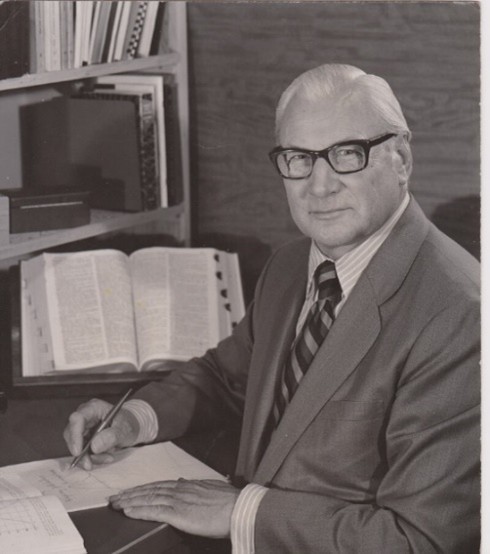
Konstantins Pocs (1912-1994) - Latvian and U.S. Scientist
Konstantins P. Pocs was born on February 27, 1912 in Poci, Malta, Vilani parish, Latvia. Until World War 2, he mostly lived in the Talavas home of his father Peters. Initially, he studied at the Vilani primary school (grade I) and the Sakstagala (Ciucines) primary school (grade II). Then, in 1929, he entered the gymnasium in Aglona, from which he graduated in 1933. In 1934, he matriculated at the Faculty of Mathematics and Natural Sciences of the University of Latvia, from which he graduated in 1940 with a mag. rer. nat. Degree. After graduating from the university, he worked for some time at the Institute for the Study of the Riches of the Earth in Riga, then from 1940 to 1944 as a physics teacher at the Rezekne State Gymnasium and the Rezekne State Commercial School. In 1944, the authorities of Nazi Germany detained and forcibly mobilized him in the artillery unit of the 15th division (Latvian Legion). In the spring of 1945, he ended up in Berlin, then Lübeck, where he waited for the end of the war. After the war, from the autumn of 1945, he lived in the camp for displaced persons in Henzen (near the city of Hamelin in West Germany). In 1945, he founded the Henzen Latvian Gymnasium there and serves as its director until 1947. During this time, he entered the German University of Göttingen, where he supplemented his knowledge of physics for a doctoral degree. In 1947 he moved to England, where he studied at the universities of Manchester and Sheffield. From 1949 to 1956, he engaged in scientific research as a physicist at the Central Laboratory of the National Coal Authority in Manchester. In England he worked at the local chapter of Daugavas Vanagi. He was also active in the work of organizing Latvian Catholics in the Manchester District of Northern England and led the local Latvian Catholic community. In 1956 he moved to Canada, where he initially worked as a geophysicist at a uranium mine in the province of Ontario. While living in Canada, he entered the University of Toronto, where he studied meteorology. From 1956 to 1958, he was a fellow at the Ontario Research Foundation in Toronto. Moved to the United States in 1958. From 1958 to 1961, he was a senior engineer at CBS Electronics in Lowell, Massachusetts. During this time, he additionally studied atmospheric physics at the University of Texas at El Paso, from which he graduated in 1961. From 1961 to 1962, he was a senior engineer at Clevair, an electronics firm in Waltham, Massachusetts. Since 1962, he worked at the U.S. Air Force Cambridge Research Laboratories in Boston, holding the positions of physicist, designer, and project manager in the following years. He worked in this laboratory for almost 30 years.
During his scientific activity he conducted research in physics, meteorology, radio electronics and a number of other areas. So, having developed meteorological missiles (as part of the US lunar research program), instrumentation for tracking rocket flights in higher layers of the atmosphere, conducted research in the construction of instruments for atmospheric pollution and wind tunnels, in the construction of microwave radio receivers, in the application of rubidium lasers in holography. He is one of the inventors of the military warning and control device AWACS (Airborne Warning and Control System). In 1970, he patented one of his inventions – a microwave antenna and a beam reduction device. He has published more than 50 articles in various scientific publications. He has lectured and spoken at several scientific conferences (Canada, USA, France, etc.). In 1963, 1966, and 1971, he received honorary diplomas and commendations from the U.S. Department of the Air Force. In 1991, he was elected honorary doctor of the Latvian Academy of Sciences (Dr. honoris causae). At the 95th anniversary event of the Fraternitas Metropolitana corporation in Boston, he was presented with an honorary doctorate by Janis Stradinš, academician of the Latvian University of Latvia. Konstantins Pocs was a member of the historical Latvian student corporation Fraternitas Metropolitana, founded in St. Petersburg in 1896. Konstantins Pocs was married to Erna Poca (b. Zingis). They had no children. At the end of his life, Konstantins Pocs lived with his wife Erna in Cape Cod, Massachusetts, near the Atlantic Ocean. Since 1956, he has been in contact with his relatives in Latvia all the time, including regularly corresponding with his brother Janis. In September 1976 he visited Latvia, meeting with relatives and close friends. After his retirement (1985), he wrote to his brother Janis: "In October, my superiors held a farewell to me. I cannot imagine, however, that elsewhere it would have been praised for doing the work entrusted to me and gifted with diplomas from the highest generals, in the presence of about 300 colleagues. This brings to an end the working phase of my life. For my accomplishments, I can so thank my father, mother, and you. You were the one who tried to show me the way to go, because the first years of the scale weren't brilliant for me, not much promised, but thanks to God's will, I was allowed to walk the hills of science and write our family name in the pages of world history."
The biography of Konstantins Pocs has been published in several media and scientific publications. A lot of information and bibliographic data about Konstantins Pocs are in the collections of the Latgale Museum of Cultural History, on the Internet, in the Encyclopedic Dictionary of Latvia. A short biography is in the publication – "Varaklani un varaklanieši. Kulturvesture, atminas, apcerejumi" (Varaklani and Varaklanians. Cultural history, memories, contemplations).
Konstantins Pocs died on May 3, 1994, after long-term health issues. He was buried on May 10, 1994 at the Gethsemane Cemetery near Boston. His funeral was reported on by the Latvian exile newspaper “Briva Latvija” (“Free Latvia”): "On May 10, Bostonians bode farewell to a great Latvian citizen and scientist Konstantins Pocs at the Gethsemane Cemetery. .. There was a full church of worshippers, and the organ played mourning music. The ark of the deceased was sinking in a mountain of spring flowers, but the Latvian national flag was covered over it, transferred from Latvia, where it had been preserved as the greatest treasure."
Between 1990 and 1994, Konstantins Pocs donated many of his materials and documents (family and service photographs, service and education documents, annotations of inventions and scientific works, specialist reviews, letters of thanks and honors from the U.S. Air Force Ministry) to the Latgale Museum of Cultural History.